

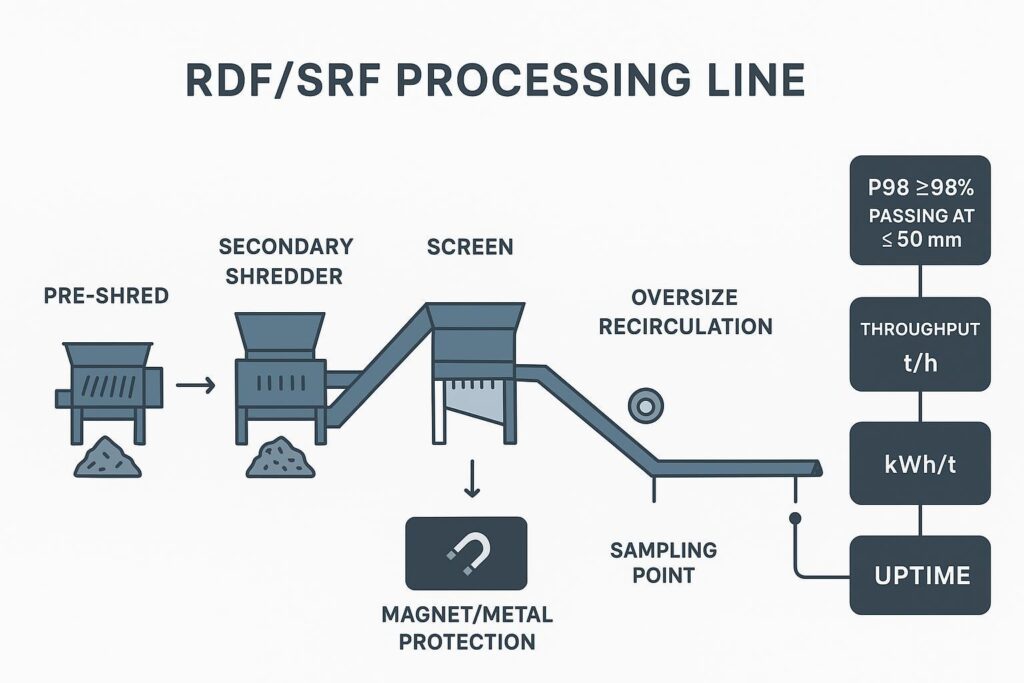
تُعد مرفوضات الأشرطة الطويلة ضريبة خفية في إنتاج الوقود البديل (RDF/SRF)؛ فهي لا تقتصر على الفشل في تلبية مواصفات غربلة الحجم فحسب، بل تزيد من حمولة إعادة التدوير، وترفع من مخاطر التكفّف والالتفاف حول الدوار، وتدفع باستهلاك الطاقة (كيلوواط ساعة/طن) إلى الارتفاع بهدوء مع خفض الإنتاجية. توضح هذه المقالة الخطوات الهندسيّة لإزالة الأشرطة الطويلة وتحقيق حجم قطع ≤50 مم بانتظام مع نسبة إنجاز تُقدّر بـ ≥98% (P98) على خطوط التحجيم المقيدة بالغربال.
إجابة سريعة:
- الهدف: إزالة مرفوضات الأشرطة الطويلة لتحقيق حجم قطع ≤50 مم بنسبة إنجاز تُقدّر بـ ≥98% (P98).
- النطاق: التقطيع والتكسير الثانوي، التحجيم المقيد بالغربال، كفاءة معالجة الوقود البديل (RDF/SRF).
- السياق المعياري: EN ISO 21640؛ القبول والإبلاغ القائم على الغربلة.
- العوامل الرئيسية: هندسة القواطع، الجزء الثابت المشطي (Comb stator)، الغرابيل/OAR، خلوص القص، التحكم في التغذية، وضمان الجودة (QA).
الخلاصة الرئيسية: Treat long strips as a مشكلة في النظام (geometry + screen capacity + gap control + feed stability). Fixing only one lever rarely holds P98 in real mixed-waste variability.
الأسباب الجذرية
Flexible films and textiles
Flexible polymers and fibrous fractions (films, big-bag scraps, textiles, straps) tend to elongate, fold, and “draw through” the cutting zone. Instead of breaking into short particles, they can slip, ride the rotor, and emerge as long ribbons.
In low-speed shear size reduction, the goal is to keep the material in a repeated shear/re-engagement loop until it passes the sizing constraint. When flexible material avoids that loop—by stretching or wrapping—you get long strips and unstable particle length distribution.
Practical signals that film/textile behavior is dominating:
- Long strips spike during wet loads, low bulk density loads, or when film fraction increases.
- Power (kW) increases without a proportional throughput increase.
- Screen blinding or rotor wrap events correlate with strip length drift.
A quick field test before changing hardware: pull a typical “strip” by hand. If it stretches significantly before tearing, you need more positive capture and re-engagement at the cutter-stator interface.
Screen carryover and open area
In a screen-limited secondary shredder, the screen is more than a sizing device—it defines how many opportunities a particle gets to be re-cut before discharge.
Two screening fundamentals matter for strip control:
- Aperture (hole size) sets the target top-size.
- Open area ratio (OAR) sets capacity to pass—how much of the screen is actually open for material passage.
When OAR is too low (or becomes effectively low due to blinding, wear lips, or poor cleaning), flexible pieces can “surf” the screen, circulate longer, and either (a) finally pass as long strips, or (b) wrap and cause downtime. Screening theory recognizes open area as a key factor for capacity: higher open area increases available passage area and capacity, while reduced open area can increase retention and lower efficiency.
Shear gap and re-engagement
“Long strips” are often a symptom of insufficient re-engagement frequency.
إذا shear gap (rotor-to-stator or knife-to-counterknife clearance) is too large, a strip can bend and slide instead of being pinched and sheared. If the gap is uneven across the rotor width, you also get selective long-strip formation—operators will report “it’s always worse on one side.”
Film and textiles amplify this sensitivity because they deform rather than fracture.
باختصار: long strips form when flexible material stretches through an oversized or uneven shear gap and gets extra passing chances from low effective screen open area—geometry, gap, and screening act as one system, not three separate problems.
تصميم القواطع والجزء الثابت (الستاتور)

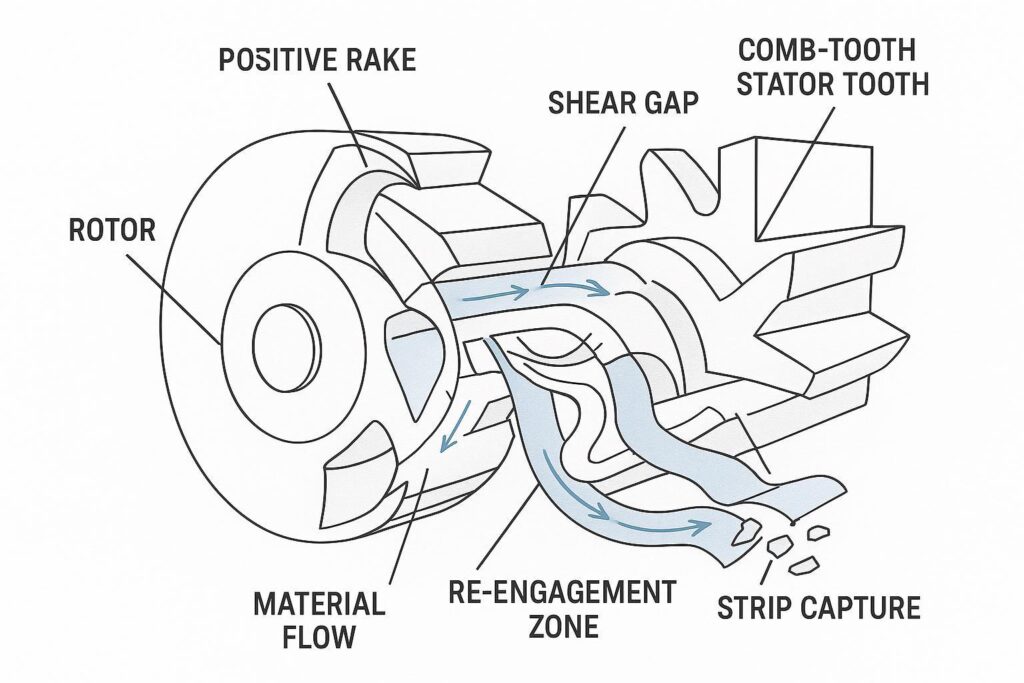
Positive-rake concave cutters
Geometry can be engineered to pull strips back into the cut instead of letting them ride through.
أ positive-rake, concave cutter profile does two useful things in strip-prone feeds:
- Capture: the concave pocket and rake angle help grab thin, flexible material rather than letting it smear.
- Re-engage: when a strip tries to escape, geometry that promotes “hook-and-return” increases the chance it meets the stator again under load.
The goal isn’t aggression for its own sake—it’s stable, repeatable engagement that shortens length without creating excessive fines.
Comb-tooth stator beds
Comb-tooth stators act like a controlled “anti-strip fixture.” Instead of a single flat anvil edge, comb teeth create multiple localized engagement points.
Benefits for strip control:
- More bite points → more chances to catch long, flexible pieces.
- Shorter unsupported spans → less ability for strips to bow away.
- More consistent presentation → less sensitivity to small changes in feed density.
In strip-heavy RDF/SRF, a comb stator is often the difference between “mostly OK” and “stable P98.”
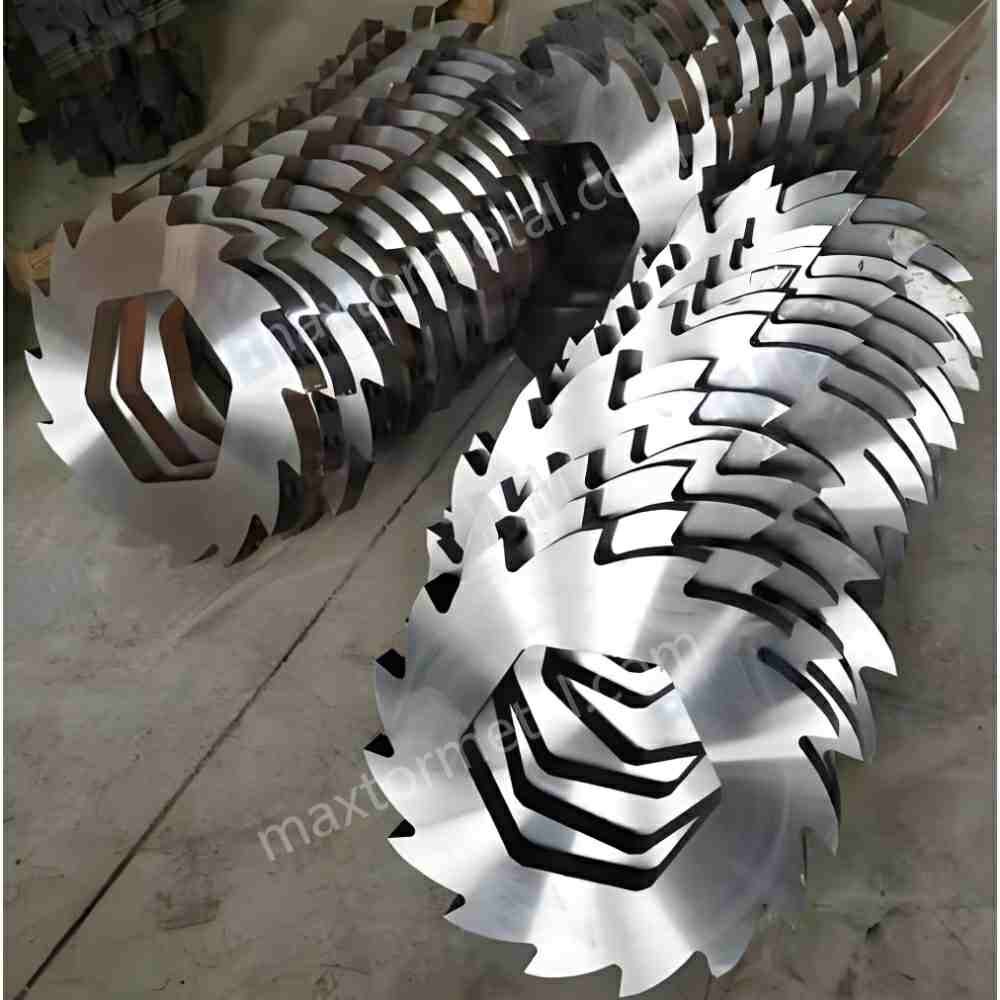
Edge prep and metallurgy
Edge sharpness matters—but in mixed waste it’s not just initial sharpness, it’s how the edge fails.
Two failure modes matter for strip control:
- Rounding (plastic deformation / wear): edges stop biting film and start pulling it.
- زرع الشرائح الدقيقة: edges develop discontinuities that increase wrap initiation and heat.
A practical QC approach—consistent with how Maxtor Metal positions its manufacturing discipline—is to treat shredder knives like a controlled wear component:
- verify incoming steel chemistry and traceability (heat/lot control),
- control heat treatment and hardness consistency batch-to-batch,
- confirm grind geometry and edge preparation against drawing tolerances,
- and validate fit-up so aftermarket knives don’t create clearance drift.
For the incoming-inspection workflow behind that verification—spec control, CMM sampling plans, and MTR documentation—see شراء سكاكين التقطيع (shredder) لخدمات ما بعد البيع: مراقبة المواصفات، خطة CMM، اعتماد MTR، والتحقق من الملاءمة الوظيفية..
That “OEM-fit” emphasis is not marketing fluff—it’s an engineering requirement. If the knife set cannot repeatably hold designed clearances and seating, you can’t hold particle size distribution.
For reference when specifying or qualifying replacement knives, the Maxtor Metal product page for Maxtor Metal shredder blades is a convenient place to align terminology and typical supply scope without turning the process discussion into a sales pitch.
باختصار: positive-rake concave cutters and comb-tooth stators work together to capture and re-engage flexible material, but the gains only hold if edge metallurgy and knife fit are controlled to spec.
الغرابيل والخلوصات
Aperture and open-area
For a spec like ≤50 mm at ≥98% passing, you’re optimizing the coarse tail—not the average size.
- Smaller apertures usually tighten the coarse end (better P98) but increase recirculation and energy.
- Higher OAR improves discharge capacity but can reduce “re-cut opportunities” if the system lets marginally-long pieces orient and slip through.
Screening references commonly define open area as the ratio of net aperture area to total screen area; higher open area increases available passage and capacity, while reduced open area can promote retention and blinding.
The right way to choose is to treat aperture and OAR as a pair and validate against both compliance and throughput.
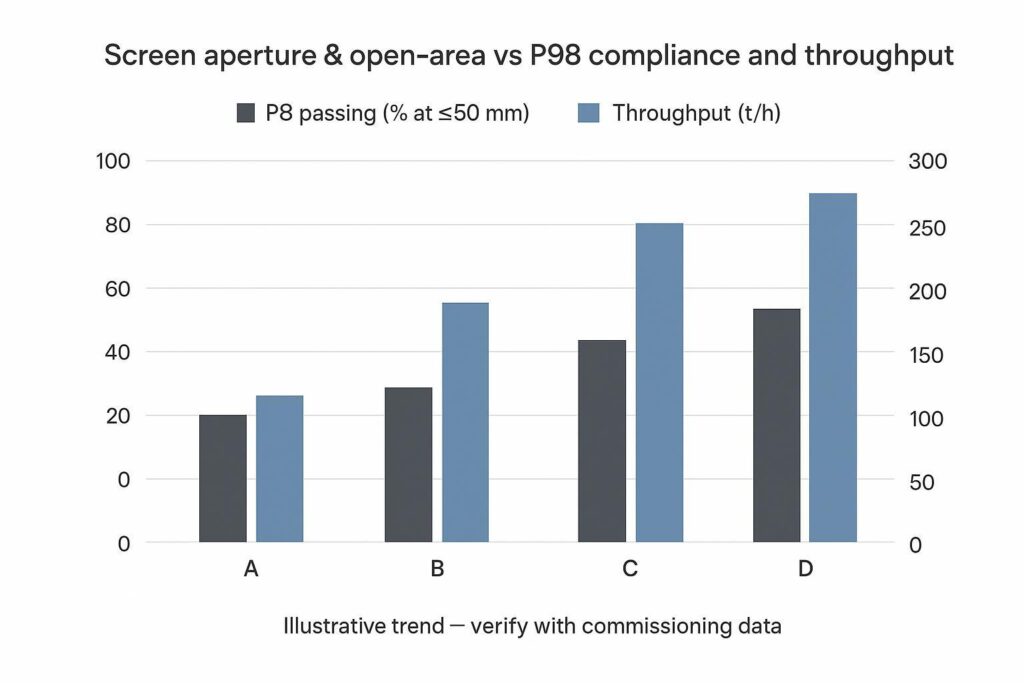
A practical commissioning pattern:
- Start with the aperture that makes the spec achievable with margin.
- Then tune OAR (screen thickness, hole pattern, anti-blinding features, cleaning) to recover throughput without sacrificing P98.
If you need a standards-aligned way to define and report “oversize” and “long particles,” SRF particle-size determination methods like EN 15415-2 (maximum projected length method for large dimension particles) provide a defensible measurement framework you can cite in acceptance documentation.
Shear-gap tolerances
Gap control is the unglamorous lever that holds everything together.
Recommendations that usually survive real-world RDF/SRF variability:
- Set a target gap و أ maximum allowable spread across the rotor width.
- Track gap drift as a maintenance KPI alongside kWh/t.
- When changing knife sets, treat clearance verification as a sign-off step, not an operator “feel” task.
For typical secondary shredder classes (e.g., 1.5 m to 2.8 m rotor width processing mixed RDF/SRF), target shear gap tolerances should be held between 0.5 mm and 1.2 mm depending on the rotor-to-stator setup. Furthermore, when reporting particle size distribution against EN 15415-2 or EN ISO 21640 standards, sampling mass and increment controls must account for measurement uncertainty (typically ±1.5% to ±2.0% P98 variance) caused by moisture variations and local film concentration.
Even small clearance changes can move you from “short chips” to “long ribbons” on film-heavy loads. The tolerance chain that keeps this gap stable across a multi-shaft rotor—GD&T callouts, spacer selective fit, and post-assembly TIR verification—is covered in علاج التآكل غير المتساوي: دليل تراكم التجاوزات المسموح بها لسكاكين المحاور المتعددة.
Anti-wrap and deflectors
Anti-wrap isn’t only about avoiding downtime; it’s about keeping the material in the intended cut path.
Effective measures include:
- rotor-end and shaft deflectors that prevent film migration into dead zones,
- scrapers that keep the screen and stator interface clean,
- and maintaining edge condition so film is sheared rather than pulled.
When wrap events are frequent, treat them as a process symptom: it often means the system is spending too long in recirculation because P98 is not being achieved efficiently.
باختصار: choose aperture for the P98 target first, then tune open-area ratio and gap uniformity to recover throughput without giving up compliance.
التحكم في التغذية والمخاطر

Residence-time stability
Residence time is the bridge between particle size and energy.
If feed swings, you can temporarily “pass” P98 by starving the chamber—but you’ll pay for it in throughput instability. Conversely, if you overload, you’ll see more smearing and strip formation.
Aim for:
- stable ram pressure / feed conveyor load,
- stable amperage profile,
- and stable recirculation return rate (oversize loop).
Tramp metal and moisture
Tramp metal triggers both performance loss and risk:
- It damages edges (accelerating strip formation).
- It forces operators to open gaps to avoid catastrophic contact.
Moisture changes friction and material handling:
- wet film and textiles are more likely to mat and wrap,
- and wet fines can blind screens, effectively reducing open area.
Upstream protection (magnets/metal detection) and moisture-aware operating windows are often the cheapest “strip control” you can buy.
Thermal growth allowances
Thermal growth shows up as clearance drift.
Even if your cold setup is perfect, sustained high-load operation can change rotor/stator relationships. If the machine design has limited thermal compensation, you may need:
- defined warm-up checks,
- thermal-state-specific gap targets,
- and stricter sign-off after long runs on high-friction feeds.
باختصار: residence-time swings, tramp metal, moisture, and thermal growth all show up as the same symptom—clearance and engagement drift—so feed stability protects the gap settings you already tuned.
مؤشرات الأداء الرئيسية، التشغيل، والعائد على الاستثمار
Sieve plans and wording
If you want acceptance that doesn’t devolve into arguments, write your test plan like a contract.
Use clear definitions and methods:
- Reference ISO 21640 for SRF specification/class framing via the ISO catalog listing for ISO 21640:2021, Solid recovered fuels — Specifications and classes.
- Define particle size reporting using a sieve method standard like ISO 2591-1:1988 (Test sieving — General principles).
- For long/oversize particles, cite a method aligned to SRF practice such as the public catalog entry for “EN 15415-2:2012 (Maximum projected length method)”.
Then specify:
- sieve stack (aperture sizes),
- sample basis (as received vs dry),
- how many increments and total mass,
- P98 calculation method,
- and pass/fail wording (including what happens on a retest).
Throughput, kWh/t, uptime
For line economics, track three KPIs together:
- Throughput (t/h): the obvious one.
- Specific energy (kWh/t): the hidden cost of over-recirculation.
- Uptime (%): wrap events and screen blinding will dominate this.
A common failure is optimizing only one metric (e.g., smallest aperture to “make spec”) and losing overall efficiency. P98 is the constraint; throughput and kWh/t are the optimization variables.
Tuning matrix and payback
Commissioning should be treated like controlled experimentation.
Build a tuning matrix with rows like:
- cutter geometry (baseline vs positive-rake concave),
- stator type (flat vs comb),
- screen aperture,
- screen OAR/condition,
- shear gap setpoint,
- feed setpoint (ram pressure/conveyor speed),
- moisture band.
Outputs:
- P98 compliance,
- throughput,
- kWh/t,
- wrap events per shift,
- knife life (hours or tons between regrinds).
Payback usually comes from a combination of:
- fewer wrap stoppages,
- lower kWh/t at the same spec,
- and longer stable intervals between gap resets/knife interventions.
Field Case Study: 15 t/h Secondary Shredding Line Optimization
Case data below is drawn from an anonymized field commissioning engagement; customer identity and site details are withheld, and results reflect this specific line configuration rather than a guaranteed outcome.
To evaluate the combined impact of cutter geometry, comb stators, and shear gap management, a performance audit was conducted on a 15 t/h commercial RDF/SRF secondary shredding line handling high-film municipal solid waste fractions.
| Parameter / Metric | Baseline Setup (Flat Stator, Conventional Blades) | Optimized Setup (Positive-Rake, Comb Stator, 0.8mm Gap) | Performance Delta |
|---|---|---|---|
| P98 Passing (≤50 mm) | 89.0% (Non-compliant) | 98.5% (Compliant) | +9.5 percentage points |
| Specific Energy (kWh/t) | 21.5 kWh/t | 18.5 kWh/t | -14.0% energy reduction |
| Throughput Stability | 12.2 t/h average | 15.1 t/h average | +23.8% effective capacity |
| Rotor Wrap Events | 3.0 stops per 8-hr shift | 0.2 stops per 8-hr shift | 93.3% reduction in wrap downtime |
By stabilizing particle re-engagement and preventing film slippage, the line eliminated over-recirculation, allowing higher throughput at a significantly lower specific energy footprint.
The optimized configuration in this engagement used Maxtor Metal comb-tooth stator blades and positive-rake cutters specified to the OEM clearance drawing—consistent with the fit-and-traceability discipline described above.
When knife fit and repeatability are part of the constraint, linking your knife specification/qualification documentation to the relevant part families helps keep procurement and maintenance aligned without turning the engineering plan into a vendor selection exercise.
باختصار: track P98, throughput, and kWh/t together, not one at a time—the case data above shows how a coordinated tuning matrix converts compliance gains into real energy and uptime savings.
FAQs:
س: لماذا تُنتِج المفرمة (Shredder) أشرطة طويلة بدلاً من حبيبات قصيرة؟
ج: تعني الأشرطة الطويلة عادةً أن المواد المرنة تتمدد أو تنزلق عبر منطقة القص بدلاً من الاحتكاك والتقطيع المتكرر. وتتمثل الأسباب الأكثر شيوعًا في كَلاَلَة/تآكل الحواف القاطعة، وجود خلوص قص (shear gap) مفرط أو غير منتظم، وحالة الغربال/نسبة المساحة المفتوحة (OAR) التي تسمح للقطع "الحدية" بالاتجاه والمرور عبر الفتحات.
س: ماذا يعني المفهوم "P98 ≤50 مم" في تحجيم الوقود البديل (RDF/SRF)؟
ج: يعني أن 98% من كتلة العينة تمر عبر معيار 50 مم (مما يترك 2% فقط من الحجم الزائد حسب الكتلة). ويركز هذا المفهوم على الفئات الخشنة من التوزيع الحبيبي، وهو المكان الذي تظهر فيه الأشرطة الطويلة.
س: كيف أختار فتحة الغربال لتحقيق حجم قطع ≤50 مم بنسبة إنجاز تُقدّر بـ ≥98% (P98)؟
ج: ابدأ بفتحة غربال يمكنها تحقيق هدف P98 مع هامش أمان في أسوأ حالات التغذية (ارتفاع نسبة الأغشية البلاستيكية/المنسوجات). ثم استرد معدل الإنتاجية من خلال تحسين المساحة المفتوحة للغربال، ومقاومة انسداد الفتحات (Anti-blinding)، واستقرار التغذية، بدلاً من توسيع فتحة الغربال على الفور.
س: ما هي "نسبة المساحة المفتوحة" (Open Area Ratio) للغربال ولماذا تؤثر على معدل الإنتاجية؟
ج: المساحة المفتوحة هي الكسر من سطح الغربال الذي يتكون بالفعل من ثقوب مفتوحة. وتؤدي النسبة الأعلى من المساحة المفتوحة عمومًا إلى زيادة المساحة المتاحة لمرور الحبيبات وتحسين القدرة الإنتاجية؛ بينما تؤدي المساحة المفتوحة الفعالة المنخفضة (بسبب التصميم أو انسداد الثقوب/blinding) إلى تقليل الإنتاجية وزيادة احتباس المواد وحمولة إعادة التدوير.
س: ما مدى الدقة المطلوبة في التفاوت المسموح به لخلوص القص (shear gap) لتقليل الأشرطة الطويلة؟
ج: يجب أن يكون ضيقًا بدرجة كافية بحيث يتم ضغط المواد المرنة وقصها بانتظام بدلاً من انزلاقها. عمليًا، المطلب الأهم هو الانتظام عبر كامل عرض الدوار (Rotor) والحفاظ على نقطة الضبط المحددة رغم التآكل والتمدد الحراري — يجب التعامل مع هذا كمعيار تفاوت محكوم يخضع لفحص واعتماد رسمي.
س: لماذا تتفاقم حوادث الالتفاف/التكفّف عندما أقوم بتضييق مواصفات حجم الحبيبات؟
ج: تؤدي المواصفات الأكثر صرامة عادةً إلى زيادة زمن بقاء المواد داخل المفرمة وزيادة حمولة إعادة التدوير. وإذا لم يتم ضبط الهندسة وخلوص القص (shear gap) ومعدات منع الالتفاف (anti-wrap) لضمان احتكاك المواد وتقطيعها بشكل نظيف، فإن إعادة التدوير الإضافية تتحول إلى خطر التفاف حول الدوار وتوقف عن العمل.
س: هل يمكن لسكاكين المفارم البديلة (Aftermarket) الحفاظ على مواصفات حجم الحبيبات مثل P98؟
ج: نعم — بشرط تصنيع السكاكين والتحقق منها للحفاظ على التوافق والتصميم الهندسي المطلوبين، بما يسمح للماكينة بالحفاظ على الخلوصات المصممة. عمليًا، يعني ذلك الثبات في علم المعادن والمعالجة الحرارية، والتجليخ/التجليخ الدقيق وفقًا للتفاوتات المحددة في المخططات، والتركيب القابل للتكرار بدقة لمنع انحراف خلوص القص.
س: ما هي الصيغة المناسبة لاختبارات القبول والتي تمنع النزاعات حول "الأشرطة الطويلة"؟
ج: حدد (1) طريقة أخذ العينات، (2) سلسلة الغرابيل والأساس المعياري، (3) كيفية حساب P98، و(4) طريقة لقياس "الحبيبات كبيرة الأبعاد" (مثل الحد الأقصى للطول المسقط). ثم اكتب معايير واضحة للقبول/الرفض وشروط إعادة الاختبار.
الخاتمة

الأشرطة الطويلة ليست عيبًا غامضًا — بل هي نتيجة متوقعة عندما تتجنب الأجزاء المرنة الاحتكاك وإعادة الإمساك بها للقص.
للقضاء بشكل منهجي على مرفوضات الأشرطة الطويلة والحفاظ باستمرار على الامتثال لمعيار P98 ≤50 مم، يجب على مدراء المصانع والفرق الفنية التركيز على ثلاثة مجالات رئيسية:
- تدابير النظام المضادة:اجمع بين السكاكين المقعرة ذات زاوية الجرف الإيجابية والاستاتورات المشطية لفرض إعادة احتكاك فعالة للأفلام المرنة. طابق فتحة الغربال مع متطلبات P98 مع الحفاظ على نسبة مساحة مفتوحة (OAR) محسّنة وبروتوكولات منع الانسداد (anti-blinding) لدعم الطاقة الإنتاجية. حافظ على خلوصات قص (shear gaps) ضيقة (0.5–1.2 مم) ومنتظمة عبر كامل عرض الدوار، مع الحفاظ على تحكم مستقر في التغذية للقضاء على تقلبات الطاقة وزمن البقاء.
- بروتوكولات قبول موثوقة ومحميّة:قم بتطبيق خطط قياسية لأخذ عينات الغربلة متوافقة مع معياري ISO 21640 وEN 15415-2. تتبّع مدى الامتثال لمعيار P98 جنباً إلى جنب مع استهلاك الطاقة النوعي (كيلوواط ساعة/طن) ومعدل الإنتاجية (طن/ساعة) تحت ظروف الحمل الأقصى للأفلام البلاستيكية، لضمان عدم تضحية مواصفات الجودة بربحية المصنع.
- التشغيل التدريجي وإجراءات التشغيل القياسية (SOPs):نفّذ مصفوفة بدء تشغيل (Commissioning matrix) منظمة لاختبار هندسة السكاكين، وإعدادات الغربال، وضبط الخلوصات. قم بإدراج الفحص الدوري للتفاوتات، ومراجعة التمدد الحراري، ومعايير استبدال السكاكين ضمن إجراءات التشغيل القياسية (SOP) للحفاظ على الأداء على المدى الطويل.
باختصار: ابدأ بمصفوفة ضبط دقيقة قصيرة تغطي هندسة السكاكين، وإعدادات الغربال، وخلوصات القص، والتغذية؛ ثم ثبّت إجراءات التشغيل القياسية (SOPs) لفحص الخلوصات، واستبدال السكاكين، وحالة الغربال؛ وبعد ذلك قم بزيادة الإنتاجية تدريجياً تحت المراقبة لضمان عدم تحقيق الامتثال لمعيار P98 على حساب وقت التشغيل الفعلي (uptime).
Article Technical Review & Expertise Notice
Author & Technical Support: جيري تشو
Role: Technical Support Specialist | After-sales Service & Application Engineering, Maxtor Metal
خبرة: 10+ years of field troubleshooting across industrial cutting, paper manufacturing, plastics size reduction, metal slitting, and timber processing applications. Specializes in solving edge-wear, burr formation, and fine dust issues in high-demand size-reduction machinery.
Professional Certifications: Project Management Professional (PMP)®, Certified Maintenance & Reliability Professional (CMRP)®.
Quality & Editorial Process: Content based on field commissioning logs, OEM tooling specs, and ISO/EN solid recovered fuel compliance frameworks. Verified by Maxtor Metal’s application engineering team.

 English
  Spanish
  Italian
  French
  Portuguese
  Russian
  German
  Arabic
  Hindi
Hindi  Vietnamese
  Indonesian
  Japanese
  Korean